A leather sectional couch is one of the most popular choices for a living room because it combines seating for a crowd, a strong look and a material that can last for many years. It also comes with a lot of decisions: genuine or faux leather, full-grain or top-grain, L-shaped or modular, with a chaise or recliners, in a small or large size and in colors from classic brown to modern gray.
This guide explains what a leather sectional is, the main types, how leather grades differ, popular colors, recliner and chaise options, size and layout, modern and mid-century styles, the best choices for different living rooms and how to clean and care for leather so it lasts. If you are shopping for a leather sectional couch for sale, use it as a checklist before you buy.
Leather sectional couch at a glance
What it is: A sofa made of connected sections, usually in an L or U shape, upholstered in leather or faux leather.
Best leather for durability: Full-grain and top-grain leather.
Budget option: Faux (synthetic) leather, which is lower in cost but usually shorter-lived.
Popular colors: Brown, cognac, black, gray, tan, white and cream.
Key checks: Size, leather type, frame, cushion fill, seating layout and care needs.
What Is a Leather Sectional Couch?
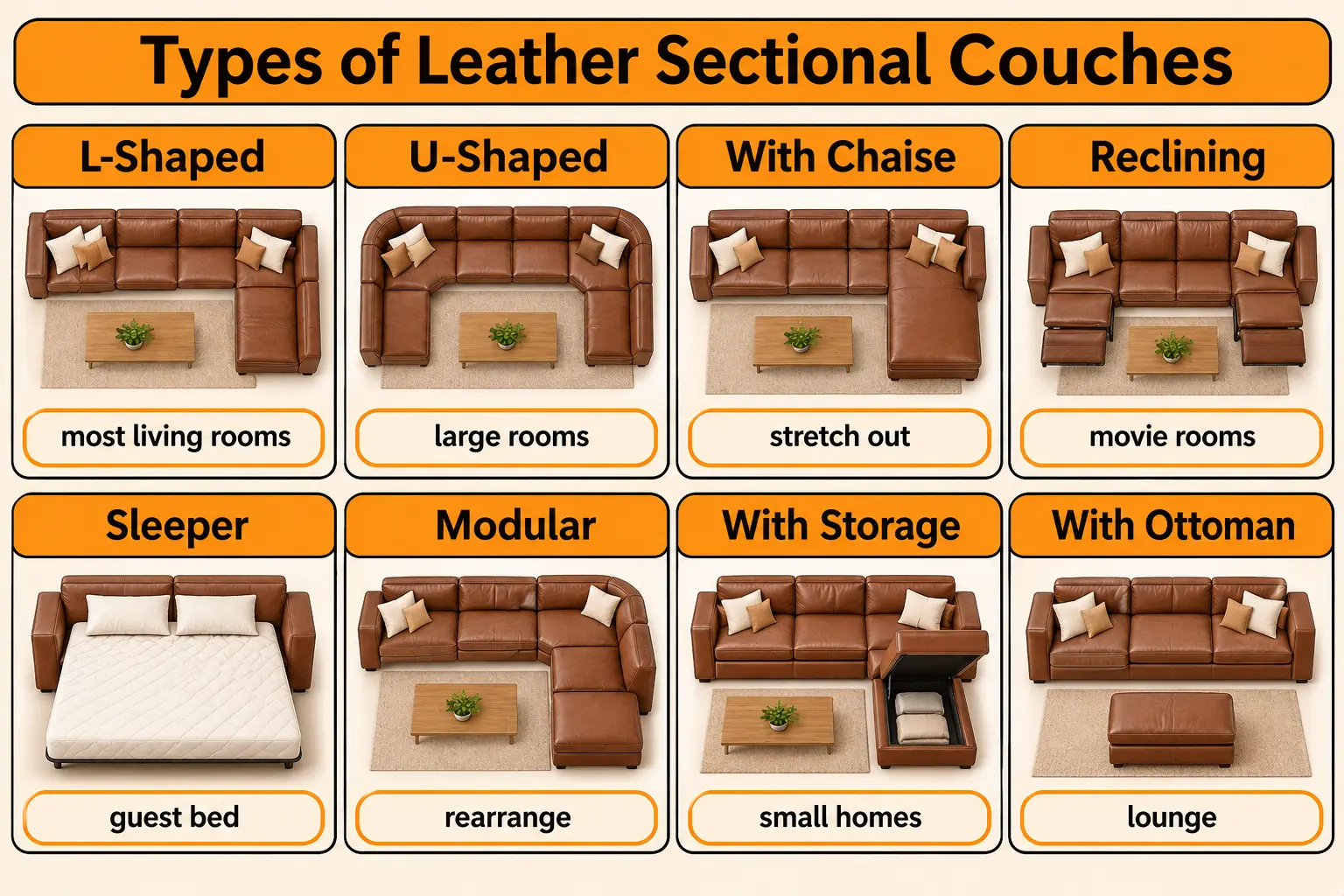
A sectional couch is a sofa made of two or more sections that fit together to form an L, U or other shape. A leather sectional couch is upholstered in leather, or in a leather-look material, and may include a chaise, recliners, a sleeper or storage. Sections can be fixed together as one piece or separate, so you can rearrange them.
People search for it in many ways: leather sectional sofa, leather couch sectional, sectional leather couch, L-shaped leather sofa or leather corner sectional. They all describe the same thing: a large, connected seating set in a leather finish.
Leather sectionals are popular because they:
Seat more people than a standard sofa in the same footprint.
Define a living room or family room layout.
Are easy to wipe clean compared with many fabrics.
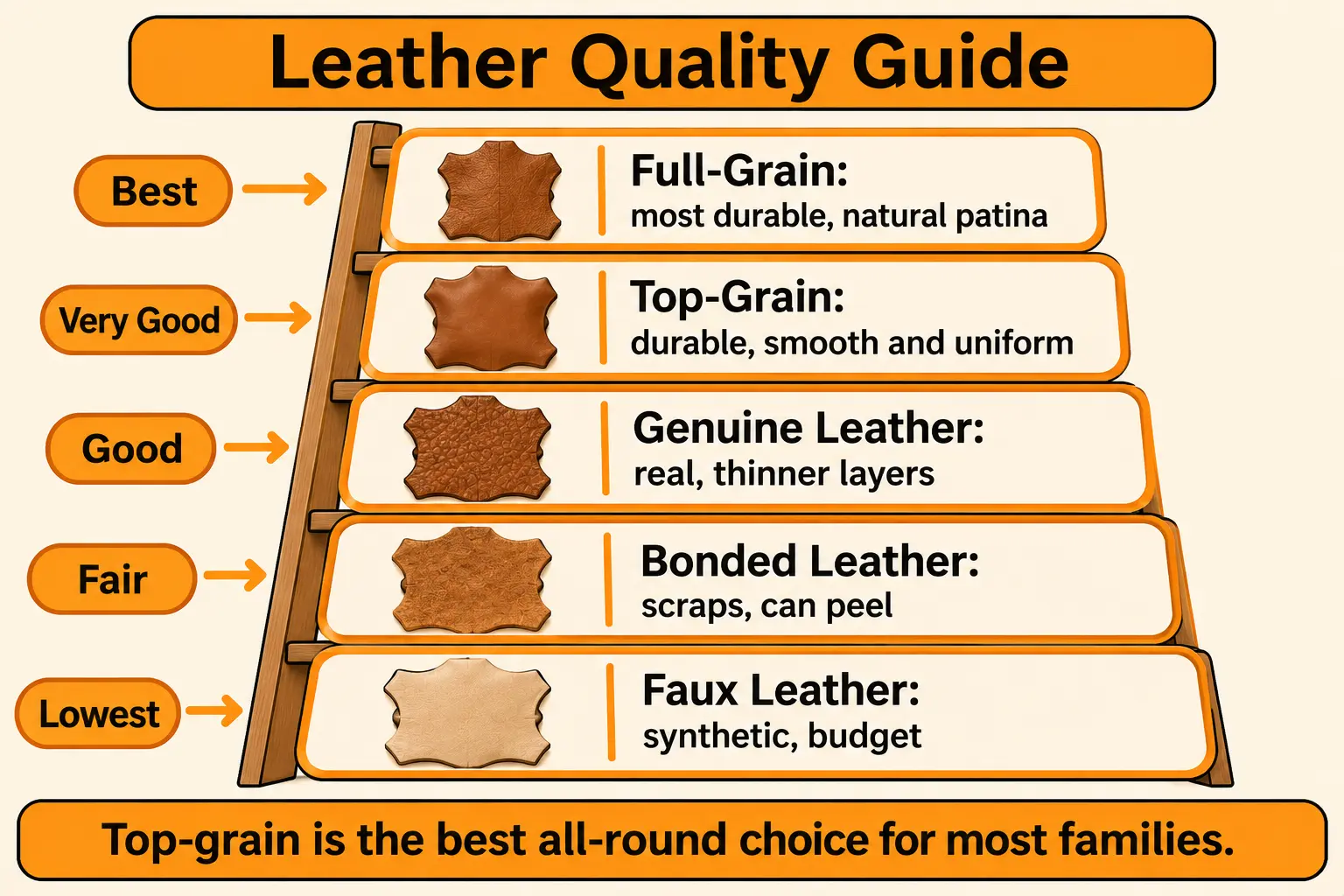
Leather labels can be confusing. The words "genuine leather" do not always mean the best quality, so it helps to know the full ladder.
Material
What it is
Durability
Feel and look
Cost
Full-grain leather
The top layer of the hide with the natural grain intact
Highest
Rich, natural, develops a patina
Highest
Top-grain leather
The top layer sanded and finished for a uniform look
High
Smooth, consistent, easy to care for
High
Genuine leather
Often made from lower layers of the hide, then finished
Medium
Real leather, but usually thinner and less durable
Medium
Bonded leather
Scraps of leather ground and bonded with a binder
Low
Can peel and flake over time
Low
Faux (PU or vegan) leather
A synthetic coating on a fabric backing
Low to medium
Looks like leather, can crack or peel with wear
Lowest to medium
Genuine vs faux in practice:
Real leather (full-grain, top-grain and good-quality genuine leather) lasts longer, breathes better and can often be conditioned and repaired.
Faux leather costs less, is easy to wipe and comes in many colors, but it is more likely to crack, peel or flake over the years and usually cannot be repaired the same way.
Bonded leather is the weakest option, so check the label and avoid it if you want a long-lasting sectional.
When shopping, read the product description for the exact leather type and where the leather is used. Some sectionals use leather on the seating surfaces and a matching vinyl on the back and sides, which is common and not necessarily a problem, but it should be stated.
Full-Grain vs Top-Grain Leather
Feature
Full-grain leather
Top-grain leather
Layer used
The complete top layer with natural markings
The top layer with the surface sanded and buffed
Look
Natural, with visible grain and marks
Smooth and uniform
Durability
Very high
High
Aging
Develops a rich patina
Ages more evenly
Stain protection
Depends on finish, some types stain easily
Usually has a protective finish, so easier to clean
Feel
Soft and natural
Smooth and consistent
Cost
Highest
High, usually lower than full-grain
Which is better? Full-grain is the most durable and develops the most character, but it costs more and can show natural marks. Top-grain is a strong middle choice: durable, uniform and easier to care for. For most families, top-grain leather offers the best balance of look, durability and price.
You may also see terms like aniline and pigmented. Aniline leather is dyed without a heavy surface coating and feels very natural, but it stains more easily. Pigmented (protected) leather has a surface coating that resists stains and fading, which makes it a practical choice for homes with kids and pets.
Leather quality guide: from full-grain at the top to faux leather at the budget end.
Popular Leather Sectional Couch Colors
Color
Look and mood
Pairs well with
Notes
Brown
Warm, classic
Cream walls, wood floors, earth tones
Hides wear well
Cognac and tan
Warm, mid-century, inviting
White walls, black accents, plants
Ages beautifully, shows light scratches
Black
Bold, modern
White or gray walls, metal and glass
Shows dust and pet hair
Gray (grey)
Modern, neutral
Almost any palette, soft textures
Easy to match
White
Clean, bright, modern
Light floors, soft color accents
Shows dirt, dye transfer and stains
Cream and beige
Soft, calm
Warm neutrals, wood
Shows dirt and needs more care
Red
Bold, statement
Neutral walls, black and gray
Strong accent, works best in a large room
Blue and green
Rich, unique
Cream, brass, warm wood
Statement color, check fade resistance
Color tips:
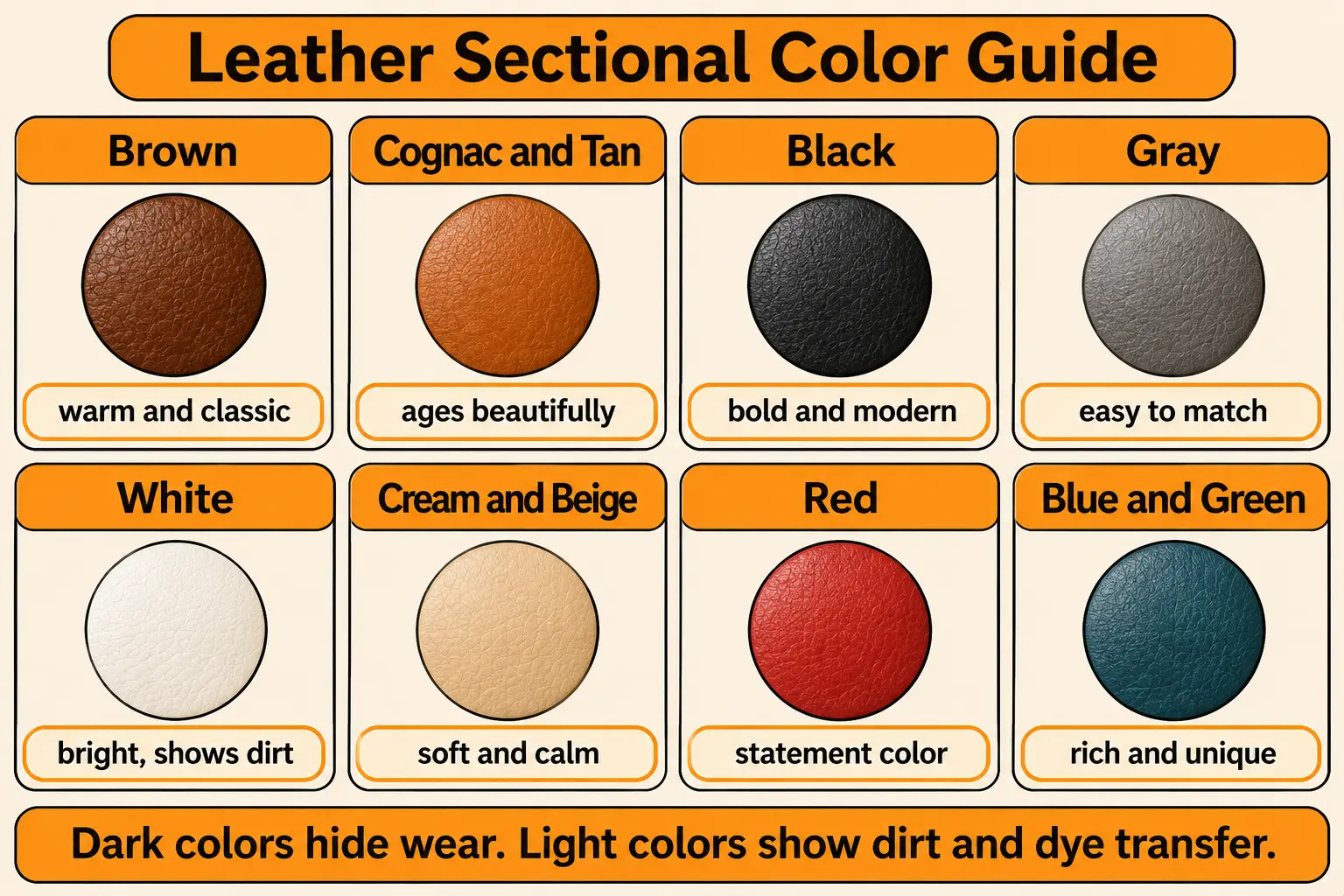
Dark colors such as brown, black and cognac hide wear and stains better, and are good for families.
Light colors such as white, cream and beige brighten a room, but show dirt, scratches and dye transfer from jeans.
Sun fades leather, so avoid placing it in direct sunlight all day.
Test samples in your room's light, since leather color can look different in daylight and at night.
Leather sectional colors and what each one means for your room and your household.
Build the whole living room around your seating
Compare complete living room sets and add coffee and end tables to match.
A reclining leather sectional adds comfort, since one or more seats recline. These are a favorite for movie rooms and family rooms.
Feature
What to look for
Why it matters
Manual vs power
Manual uses a lever or push-back, power uses a button and outlet or battery
Power is easier to use but needs an outlet
Number of recliners
One, two or every seat
More recliners means a bigger footprint
Wall clearance
Wall-hugger recliners need only a few inches behind them
Saves space against a wall
Reclined length
The stated length when fully reclined
Make sure there is floor space
Console
Center console with cup holders or storage
Convenience, but reduces seats
Power features
USB ports, power headrest, lumbar
Comfort extras
Weight capacity
A clearly stated rating
Safety and durability
Motor warranty
A clear warranty on motors and electronics
Motors are the part most likely to need service
A leather sectional couch with recliner is great for comfort, but it is bulkier than a standard sectional. Measure the room and leave clearance for the reclined position.
Leather Sectional Couch with Chaise
A chaise sectional has a long lounging section on one end, so you can stretch out and put your feet up. It is one of the most popular sectional designs, and the leather chaise sectional is common in modern living rooms.
Fixed vs reversible: A fixed chaise stays on one side. A reversible chaise can be moved to the left or right, which is useful if you may rearrange the room later.
Left or right side: Sectionals are described by the side the chaise is on when you face the sofa. Left-arm facing (LAF) and right-arm facing (RAF) are the common terms, so check which one matches your room.
Storage chaise: Some chaises lift to reveal storage for blankets and pillows.
Sleeper chaise: Some chaises convert to a bed. A leather sectional with a sleeper or pull-out bed suits guests, but the mattress is usually thin, so check comfort.
A chaise works well in small and medium rooms, because it gives lounging space without the width of a full U-shape.
L-Shaped vs Modular Leather Sectionals
Feature
L-shaped sectional
Modular sectional
Design
Two sections joined at a corner, often fixed
Separate pieces you connect and rearrange
Flexibility
Limited, may be reversible
High, you can change the layout
Room fit
Best for rooms with a clear corner
Good for small, irregular or changing rooms
Moving and delivery
Larger pieces, harder to move
Individual pieces are easier to carry
Expansion
Usually fixed in size
Can add pieces later if the line continues
Cost
Often lower
Can be higher, depends on pieces
Best for
Simple, stable layouts
Flexible layouts and small spaces
An L-shaped leather sectional is a simple and popular choice. A modular leather sectional is better if you move often, have narrow doors and stairs or want to change the layout. Check that connectors are strong and that the sections stay together.
Small vs Large Leather Sectional Couches
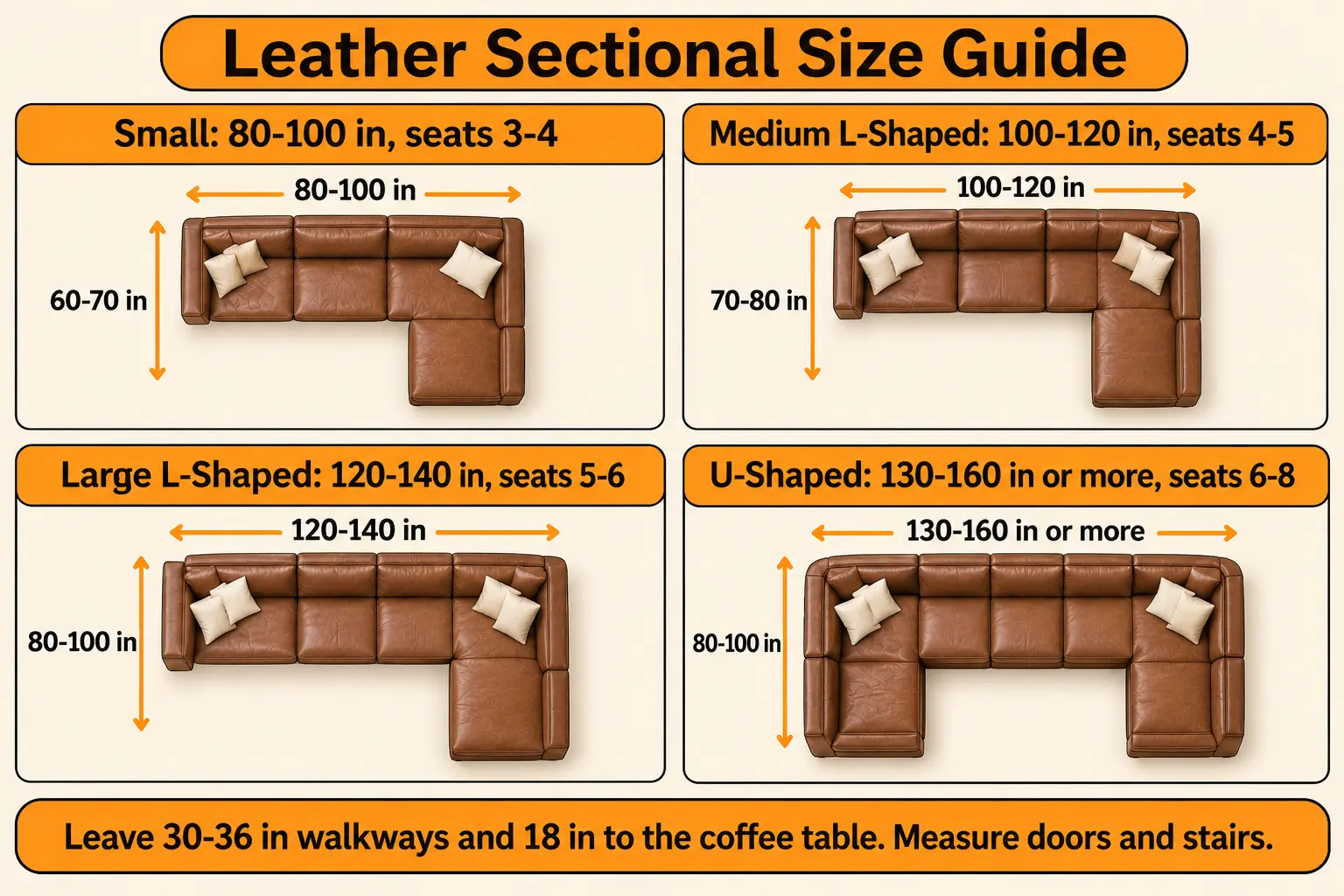
Size is the most important buying decision. Sectionals vary a lot, so the ranges below are typical guides. Always check the exact dimensions.
Size
Typical overall length
Seats
Best for
Small (apartment or compact)
About 80 to 100 in
3 to 4
Small living rooms and apartments
Medium L-shaped
About 100 to 120 in
4 to 5
Most living rooms
Large L-shaped
About 120 to 140 in
5 to 6
Large living and family rooms
U-shaped
About 130 to 160 in or more
6 to 8
Large rooms and big families
Other typical dimensions: seat depth of about 22 to 26 inches, overall depth of about 35 to 40 inches and seat height of about 17 to 20 inches. The chaise side is often about 60 to 70 inches long.
How to measure for a sectional
Measure the room and mark the sectional's footprint on the floor with painter's tape.
Leave walkways. Plan 30 to 36 inches for main paths and about 18 inches between the sectional and the coffee table.
Check the entry path. Measure doorways, hallways, stairs and elevators, since a large sectional may arrive in pieces.
Check the corner. Leave enough room for any recliners, and keep leather away from heaters and direct heat.
Tapered wood legs, tufting or simple seams, warm tones
Cognac, tan or brown
Retro and warm rooms
Rustic and industrial
Distressed leather, wood and metal details
Brown, tan or dark cognac
Cabins and loft spaces
Traditional
Rolled arms, button tufting, high backs
Brown or black
Classic living rooms
Transitional
A mix of clean lines and soft shapes
Gray, greige or tan
Most homes
With LED lighting
Built-in LED lights, USB ports
Black or gray
Media rooms and game rooms
A leather sectional couch with LED lights usually adds under-sofa or cup-holder lighting and USB ports. It is fun for media rooms, but it needs a nearby outlet, so check the power requirements.
Best Leather Sectional Couches for Living Rooms
The best leather sectional depends on your room and your household. Use this guide to match the type to your situation.
Your situation
Best choice
Why
Family with young kids
Top-grain or pigmented leather in brown, gray or black
Durable, easy to wipe, hides wear
Pet owners
Pigmented or top-grain leather in a mid-tone color
Resists scratches and stains better than aniline
Small living room or apartment
Small L-shaped or modular sectional
Fits the space and moves through narrow entries
Large living or family room
Large L-shaped or U-shaped sectional
Seats a crowd and anchors the room
Movie room
Reclining sectional with a console
Comfort and cup holders
Frequent guests
Sectional with a sleeper chaise
Doubles as a guest bed
Modern look
Low-profile top-grain leather in gray, black or white
Clean and minimal
Warm, classic look
Cognac or brown full-grain or top-grain
Ages beautifully
Budget-conscious
Quality faux leather or bonded-free options
Lower cost, shorter lifespan
To build the full room, pair your sectional with a TV stand, coffee and end tables and a slim accent cabinet for storage. For ideas on a daybed as an alternative seat in a small room, see our guide to the daybed sofa.
How to Choose the Right Leather Sectional Couch
Measure the room and the entry path before you look at any sofa.
Choose the leather type. Top-grain is a strong all-round choice, full-grain is the most durable and faux leather is a budget option.
Choose the configuration. L-shaped, U-shaped, chaise, recliner or modular, matched to your room and how you sit.
Pick the color based on your household, light and style.
Check the frame and cushions. Look for a solid hardwood or kiln-dried frame, high-density foam and strong springs or webbing.
Test comfort. Seat depth, height and firmness matter for daily use, so sit on it if you can.
Read the care and warranty terms. Look for a clear warranty on the frame, leather and any mechanisms.
Compare the final price. Include delivery, assembly and any protection plan.
Check
What to look for
Why it matters
Leather type
Stated clearly in the description
Decides durability and cost
Frame
Solid hardwood or kiln-dried, no thin particleboard
Long-term strength
Cushions
High-density foam, possibly wrapped with fiber or down
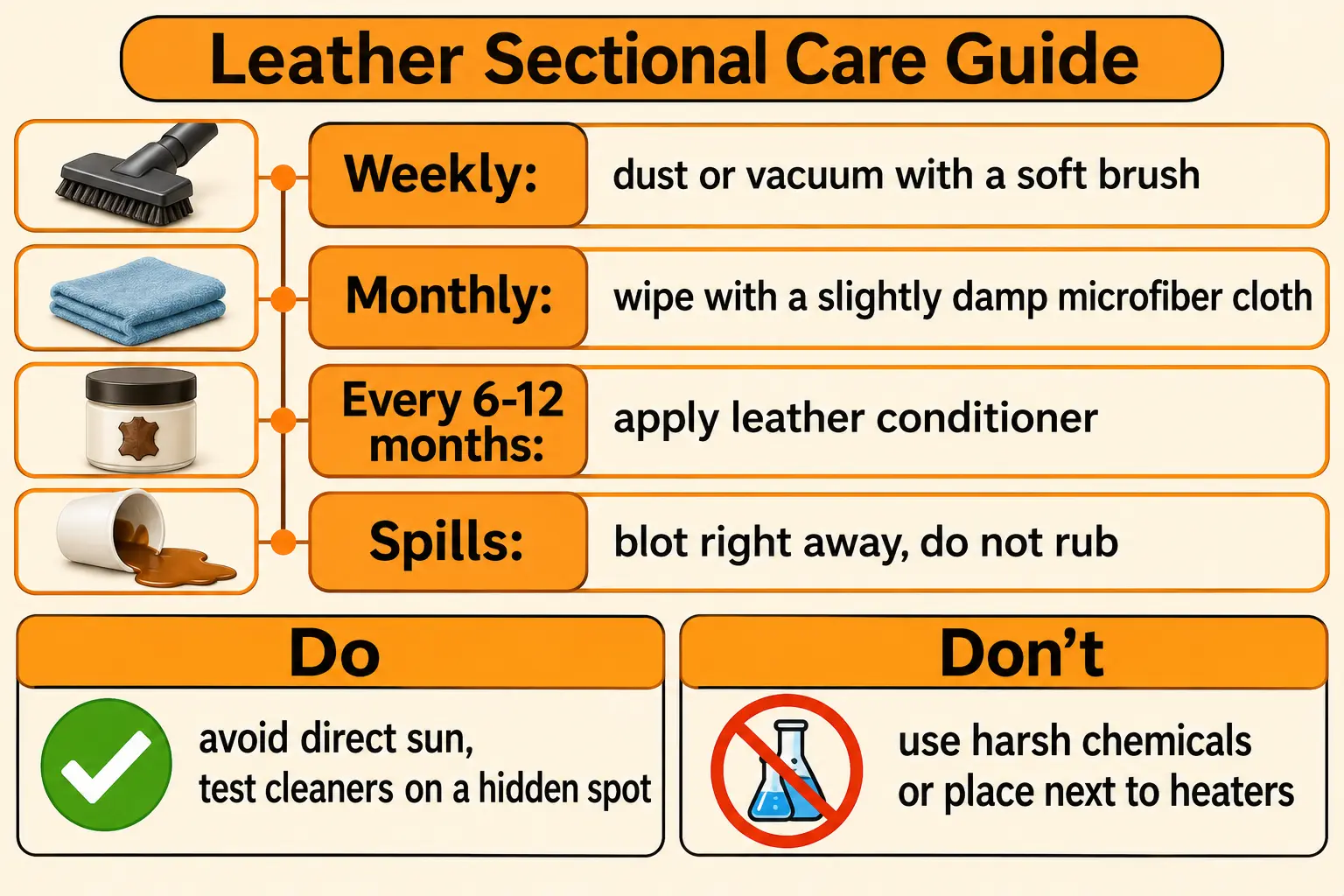
Leather lasts longer when you care for it. These steps work for most finished leather, but always check the manufacturer's care instructions first, and test any product on a hidden spot.
Routine care
How often
What to do
Weekly
Dust or vacuum with a soft brush attachment, including seams and crevices
Every month
Wipe with a slightly damp microfiber cloth and dry right away
Every 6 to 12 months
Apply a leather conditioner made for your leather type
As needed
Blot spills right away with a clean, dry cloth, and do not rub
Do and don't
Do
Do not
Keep leather out of direct sunlight
Place it right next to a heater or radiator
Keep it at least a couple of feet from heat sources
Use harsh chemicals, bleach, ammonia or alcohol
Use a leather-safe cleaner and conditioner
Use furniture polish, oils or household sprays
Rotate and fluff cushions
Let sharp objects, pet claws or rivets scratch it
Test any cleaner on a hidden spot first
Soak the leather or use a steam cleaner
Leather sectional couch covers and protectors
A cover or throw can protect leather from pets, kids and sun. Choose a non-slip, breathable cover made for leather, since a slippery cover can slide and some materials can transfer dye. Avoid plastic covers, which trap heat and moisture.
Faux leather care
Faux leather is easier to wipe, but it should not be conditioned with leather products. Use a damp cloth with mild soap, dry it fully and avoid heat and sharp objects. Cracks and peeling in faux leather usually cannot be repaired the way real leather can.
A simple care schedule to keep a leather sectional looking good for years.
Conclusion: Choose a Leather Sectional Built for Your Life
The best leather sectional couch is the one that fits your room, suits your household and matches your budget. Start with measurements, choose the leather type that fits how you live (top-grain is the best all-round choice, full-grain is the most durable and faux is the budget option), pick a layout and color that suits the room and plan on simple, regular care. A good leather sectional can anchor your living room for many years.
For many households, yes. Real leather, especially top-grain and full-grain, is durable, easy to wipe and can last many years with basic care, while faux leather usually wears out sooner. A leather sectional costs more than a basic fabric one, but it can be a good long-term value for families, pet owners and busy living rooms. If your budget is tight, a quality faux leather is a lower-cost option, but expect a shorter lifespan.
What is the difference between genuine leather and faux leather?
Genuine leather is made from real animal hide, although the term can include lower layers of the hide that are less durable than top-grain or full-grain leather. Faux leather is a synthetic material, usually a polyurethane or vinyl coating on a fabric backing. Real leather lasts longer, breathes better and can be conditioned, while faux leather costs less and is easy to wipe but is more likely to crack or peel over time.
Is full-grain or top-grain leather better for a sectional?
Full-grain leather is the most durable and develops a rich patina, but it costs more and can show natural marks. Top-grain leather is sanded and finished for a smooth, uniform look, is easier to care for and costs less. For most families, top-grain is the best balance of durability, appearance and price, and full-grain is a premium choice for those who want maximum longevity.
How do you clean a leather sectional?
Vacuum with a soft brush attachment weekly, wipe with a slightly damp microfiber cloth monthly and dry immediately. Condition the leather every 6 to 12 months with a product made for your leather type. Blot spills right away, keep the sectional out of direct sun and away from heat sources and avoid harsh chemicals. Always check the manufacturer's care instructions and test cleaners on a hidden spot first.
What size leather sectional fits a small living room?
A small or apartment leather sectional of about 80 to 100 inches long suits many small living rooms, and a modular sectional is easier to move through narrow doors and stairs. Measure the room, mark the footprint with painter's tape and leave about 30 to 36 inches for walkways and 18 inches to the coffee table. A chaise sectional gives lounging space without the width of a full U-shape.