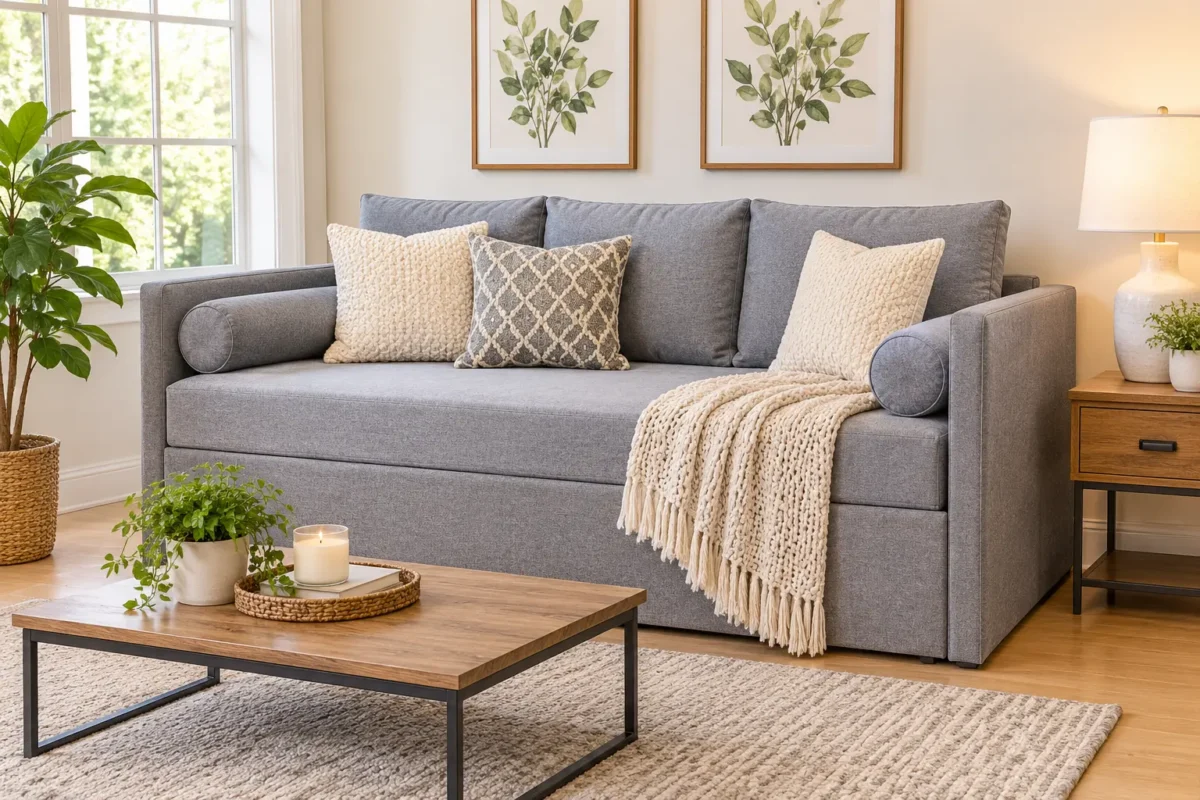
A daybed sofa is a piece of furniture that works as a couch by day and a bed by night. It looks like a sofa with a back and two arms, but it is built around a twin-size mattress, so it can switch from seating to sleeping without folding, pulling out or converting. That makes it one of the most flexible pieces for small living rooms, home offices and guest rooms.
This guide explains what a daybed is, how it works, how it compares with a regular sofa, a sleeper sofa, a sofa bed and a futon, whether you can use one as your living room sofa, which styles work best, what sizes to expect and how to style a daybed so it looks like a real sofa and not a bed in the living room.
Daybed sofa at a glance
What it is: A frame with a back and arms (or a back and one arm) built to hold a mattress.
Typical mattress: Twin size, 38 x 75 inches, with full-size daybeds available too.
Best for: Small living rooms, guest rooms, home offices, studios and teen rooms.
How it differs from a sleeper sofa: A daybed uses a standard mattress, not a thin folding one hidden inside a sofa.
Styling trick: Add a bolster and back cushions, and it reads as a sofa.
What Is a Daybed Sofa?
A daybed is a piece of furniture that combines a sofa and a single bed. It has a frame, a back and usually two arms, and a standard mattress that sits on a platform or slats inside the frame. By day, the mattress is the seat and cushions line the back. By night, you remove the cushions and it is a bed.
People also call it a day bed, daybed couch, day bed couch, sofa daybed, day sofa bed or daybed sofa bed. The names are interchangeable, and they all describe the same idea: a sofa-shaped bed.
The daybed has been used for centuries as a place to rest during the day, and modern versions come in metal, wood and upholstered designs. Many have a trundle that slides out, so the bed can sleep two.
How Does a Daybed Work?
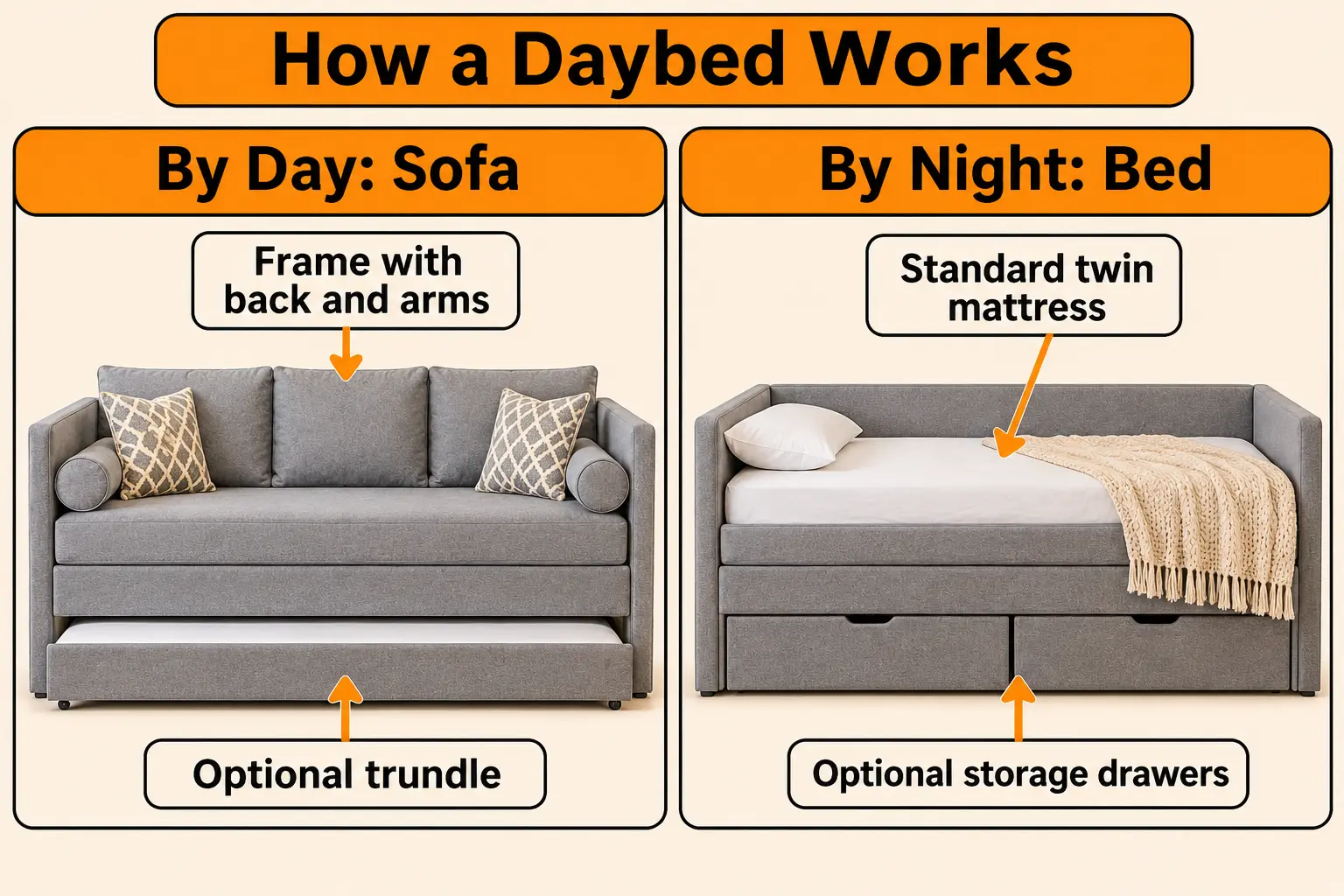
A daybed is simple, with no folding or pulling out.
The frame has a back and two arms (or a back and one arm) and holds the mattress.
The mattress is usually a standard twin mattress that sits on slats or a platform inside the frame.
By day, you arrange cushions or bolsters along the back and arms, so it reads as a sofa.
By night, you move the cushions aside and it becomes a bed.
Optional trundle: A second bed slides out from underneath, and some models raise to the same height as the main bed to make a larger sleeping surface.
Optional storage: Some designs have drawers beneath the mattress.
Because the mattress is part of the seat, you never have to fold or unfold anything, which makes a daybed easy to switch back and forth every day.
How a daybed works: a sofa by day and a bed by night.
Ready to plan your living room?
Browse living room furniture at My Furniture Mart, with delivery across the USA. Questions before you order? Call us.
The main difference is purpose. A sofa is built for sitting, and a daybed is built for sleeping, with the sofa look as a bonus. If your living room needs seating every day and a bed only occasionally, a sofa or a sofa bed may suit you better. If you want a real bed that doubles as seating, a daybed is better.
Daybed vs Sleeper Sofa vs Sofa Bed
These three terms are often mixed up.
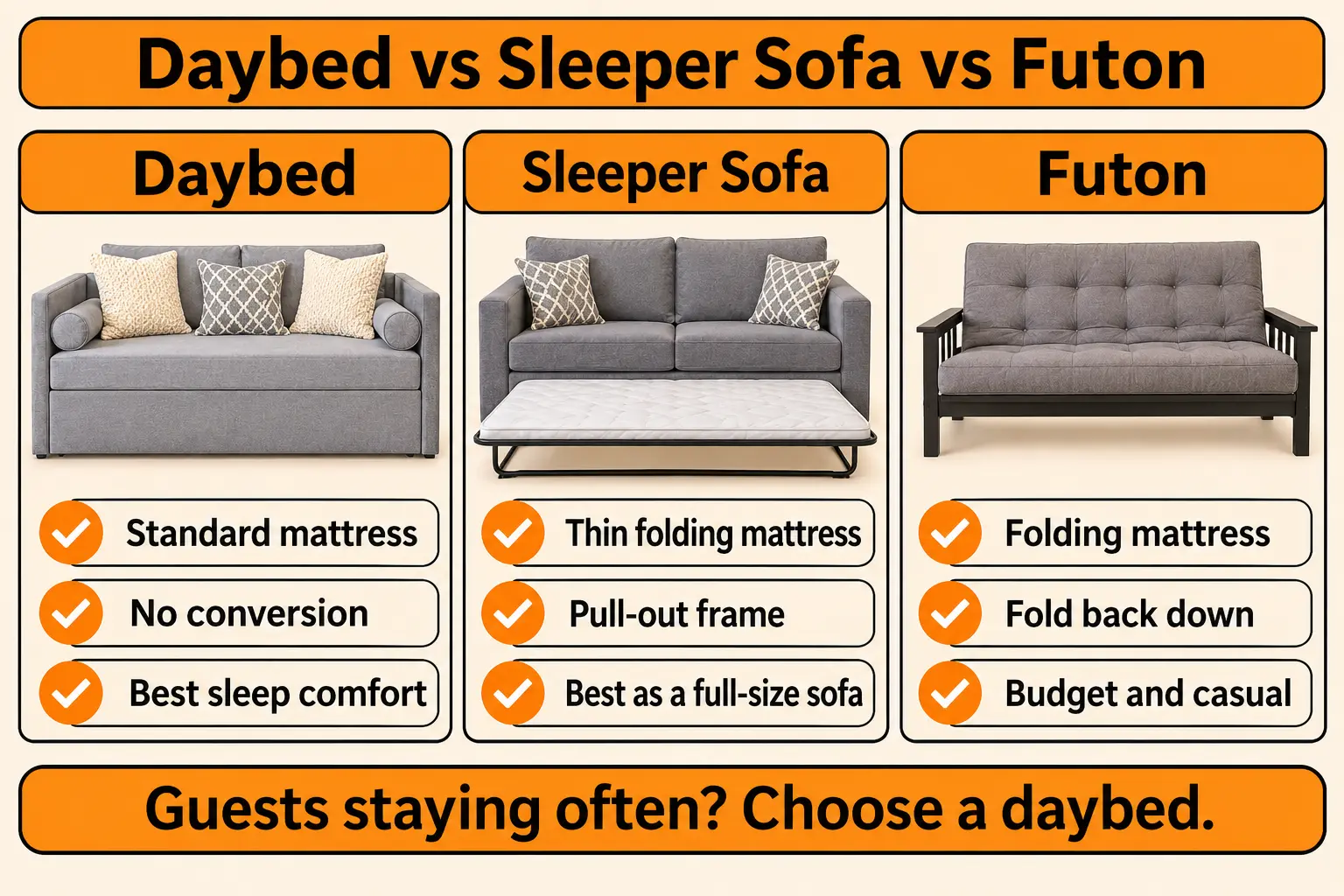
Daybed: A sofa-style frame with a standard mattress that stays in place.
Sleeper sofa (pull-out sofa): A sofa with a folding mattress and metal frame hidden inside. You remove the cushions and pull out the bed.
Sofa bed: A general term for any sofa that converts into a bed, including sleeper sofas, futons and click-clack sofas.
Feature
Daybed
Sleeper sofa (pull-out)
Futon
How it converts
It does not, the mattress is always flat
Pull out a hidden frame
Fold the back down to flat
Mattress
Standard twin or full
Thin folding mattress, often about 4 to 5 in
Futon mattress, often about 6 to 8 in
Sleep comfort
Best of the three
Varies, bar under the mattress can be felt
Fair to good, varies by mattress
Daily sitting comfort
Good with cushions
Good, built as a sofa
Fair, can feel firm
Effort to convert
None
Moderate, heavy to pull out
Easy
Space needed to sleep
None, already a bed
Extra floor space to pull out
Space to fold down
Best for
Guests, small rooms, daily use as a bed
Occasional guests in a main sofa
Casual and budget setups
If a guest will sleep there often, a daybed gives the best sleep and the least effort. If you need a full-size sofa for daily family seating and a bed a few times a year, a sleeper sofa is a better fit.
Daybed vs sleeper sofa vs futon: how they convert, sleep and sit.
Not sure which setup suits your space?
Send us your room size and how often you host guests, and we will help you choose.
Yes, and many people do. A daybed can work as the main sofa in a small living room, studio or apartment, or as a secondary seat in a larger room. Whether it works for you depends on how you sit.
A daybed works as a living room sofa when:
You have a small room and a regular sofa would crowd it.
You want a bed for guests without a separate guest room.
You mostly lounge, read or nap rather than sit upright for hours.
You add a bolster, back cushions and throw pillows for support.
A daybed may not be the best sofa when:
You have a large family that needs seats for many people.
You watch a lot of TV sitting upright and need deep back support.
You want a standard sofa depth and height, which most daybeds do not provide.
Tips to make a daybed work as a sofa:
Push it against a wall, so the long side becomes the back and you can lean on pillows.
Add firm back cushions so you can sit upright comfortably.
Choose a daybed with a solid back and arms, so it reads as a sofa and gives support.
Leave about 18 inches to a coffee table and 36 inches for a walkway.
Pair it with a chair or two for conversation seating.
For a sofa look, choose an upholstered or solid-wood daybed with a back and two arms. For a light, small-space look, a metal daybed is slimmer and more open.
The best daybed styles for living rooms, from upholstered to metal and wood.
Compare bed sizes for your space
Browse twin and full beds, or explore kids and teen furniture for flexible small rooms.
Most daybeds are built for a twin mattress, and some are made for a full.
Size
Mattress (W x L)
Typical frame footprint*
Best for
Twin daybed
38 x 75 in
About 42 x 79 in
Small rooms, single sleepers, guest rooms
Full daybed
54 x 75 in
About 57 x 79 in
Larger living rooms, more comfortable sleep
Twin trundle (pull-out)
38 x 75 in
Fits under the main bed
Second sleeper
*Frame sizes vary by brand, backs and arms add width and length, and some designs are larger. Check the exact dimensions on the product page.
Other details to check:
Seat height: The top of the mattress is typically about 18 to 24 inches from the floor, which is similar to a sofa.
Back height: Often about 28 to 36 inches, lower than many sofas.
Mattress thickness: Many daybeds are designed for mattresses up to about 6 to 9 inches thick. A thicker mattress can sit too high above the frame.
Mattress type: A standard twin mattress fits, but check the frame's size and slat or platform support. See our guide on how to choose a bed frame for support details.
Sheets: A twin fitted sheet fits a twin daybed, and a full fitted sheet fits a full. See our bed and sheet size chart dimensions for exact sizes.
Which is better? Choose a daybed if sleep comfort and a sofa look matter most, and you want a bed that never has to be unfolded. Choose a futon if budget is the main factor and you need the bed only occasionally.
How to Choose a Daybed for Small Spaces
Measure the room and the wall. A twin daybed is about 79 inches long, so check that it fits along a wall with space for walkways.
Choose the right size. A twin is best for small rooms, and a full suits larger rooms and more comfortable sleeping.
Pick a style with a back and arms if it will be your sofa, or a lighter metal style if you want a more open look.
Think about a trundle or storage. A trundle adds a second bed, and drawers replace a dresser. Check the floor space to pull them out.
Check the construction. Look for sturdy slats, a center support, solid joints and a stated weight capacity.
Plan the mattress. Make sure the mattress thickness fits the frame, and that the mattress feels comfortable for both sleeping and sitting.
Think about the room's other furniture. Leave about 18 inches to a coffee table and 36 inches for walkways. See our bedroom furniture layout ideas for spacing tips.
Daybed buying checklist
Measured the room, doorways and stairs
Chosen twin or full size
Chosen a style with the back and arms you need
Checked slats, center support and weight capacity
Checked the mattress thickness limit
Planned space for a trundle or drawers if needed
How to Style a Daybed Like a Sofa
Styling is what turns a daybed from a bed into a sofa.
Push it against a wall. The wall becomes the back, and you can lean on pillows.
Add back cushions. Use two or three large square cushions (about 24 inches) along the back, with firm inserts for support.
Add a bolster or two. Long bolsters at the arms give a classic daybed look and a place to rest.
Use a duvet or throw cover. Choose a tailored cover or a fitted daybed cover in a sofa-like fabric.
Layer textures. Mix linen, velvet and knit for a cozy, finished look.
Use a bed skirt or tailored base to hide the frame legs and give a sofa silhouette if the frame is open.
Add a throw blanket folded at the foot for comfort and color.
Pair it with a coffee table and side table to define the seating area.
Add a rug. A rug under the front legs anchors the daybed and the seating area.
Balance with lighting. A floor lamp or wall light beside the daybed completes the corner.
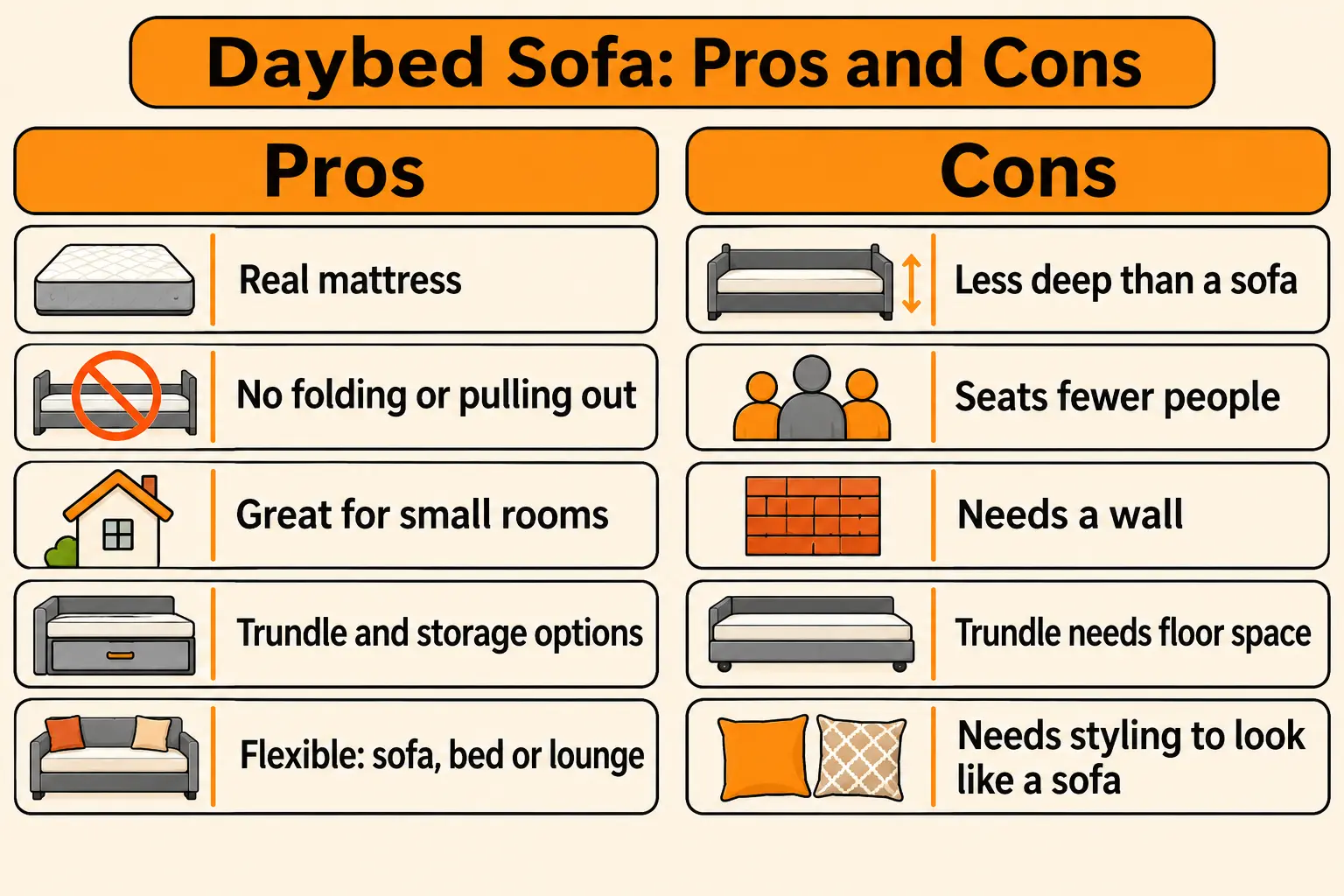
Real mattress for better sleep than most sofa beds
Back and arms can feel less deep than a regular sofa
No folding or pulling out
Seats fewer people than a standard sofa
Works for small rooms, studios and guest rooms
Long and narrow shape needs a wall
Many styles with trundle or storage
Trundle needs floor space to pull out
Flexible as a sofa, a bed or a lounge
Can look like a bed if not styled well
Simple, durable construction
Needs bedding and cushions to look finished
Good for kids, teens and guests
Not ideal as the only seating for a large family
Daybed sofa pros and cons at a glance.
Conclusion: Is a Daybed Sofa Right for You?
A daybed sofa is a good choice if you want a real bed that doubles as seating, especially in a small living room, studio, home office or guest room. It sleeps more comfortably than most sofa beds, never needs unfolding and looks like a sofa when you add the right cushions. If you need deep seating for a large family every day, a regular sofa or sleeper sofa may suit you better.
A daybed is a piece of furniture that works as both a sofa and a bed. It has a frame with a back and usually two arms, and it holds a standard mattress, most often a twin. By day, cushions and bolsters make it a seat, and by night it is a bed. Many daybeds also have a trundle or storage drawers.
Can a daybed be used as a sofa?
Yes. A daybed can work as the main sofa in a small living room or studio, or as an extra seat in a larger room. Push it against a wall, add firm back cushions and bolsters for support and leave space for a coffee table. It is best for lounging and occasional seating, and less ideal if you need deep upright seating for a large family.
Is a daybed or a sleeper sofa more comfortable?
For sleeping, a daybed is usually more comfortable because it uses a standard mattress, while a sleeper sofa uses a thin folding mattress with a frame underneath. For sitting, a sleeper sofa is built like a regular sofa and is often better for long upright sitting. Choose a daybed if guests sleep over often, and a sleeper sofa if you need a full-size sofa and only need the bed occasionally.
Is a daybed the same as a futon?
No. A daybed has a fixed frame with a back and arms and holds a standard mattress that stays flat. A futon is a frame that folds from a seat into a bed, and it uses a thinner folding mattress. A daybed is generally more comfortable to sleep on, and a futon is often a lower-cost, more casual option.
What size mattress does a daybed use?
Most daybeds use a twin mattress, which is 38 x 75 inches. Some daybeds are made for a full mattress, which is 54 x 75 inches. Check the frame's maximum mattress thickness, often around 6 to 9 inches, and use a twin or full fitted sheet to match the mattress. Always check the product page for exact sizes.