A bunk bed saves floor space and kids love it, but the top bunk is a real fall risk if the safety features are missing or wrong. The most important of those features is the safety rail, also called a guardrail. It is the barrier that keeps a sleeping child from rolling off the edge, and it has to be the right height, the right strength and free of dangerous gaps.
This guide explains what a bunk bed safety rail is, why it matters, the main types, how safety rails compare with safety nets, what the US safety standards require, what age is safe for the top bunk, how high a rail should be, how to install one, ladder safety, RV and camper bunks, DIY ideas and how to choose the right rail.
Safety note: This article is general information. Always follow the bed manufacturer's instructions and check current guidance from the US Consumer Product Safety Commission (CPSC) at cpsc.gov.
Bunk bed safety rails at a glance
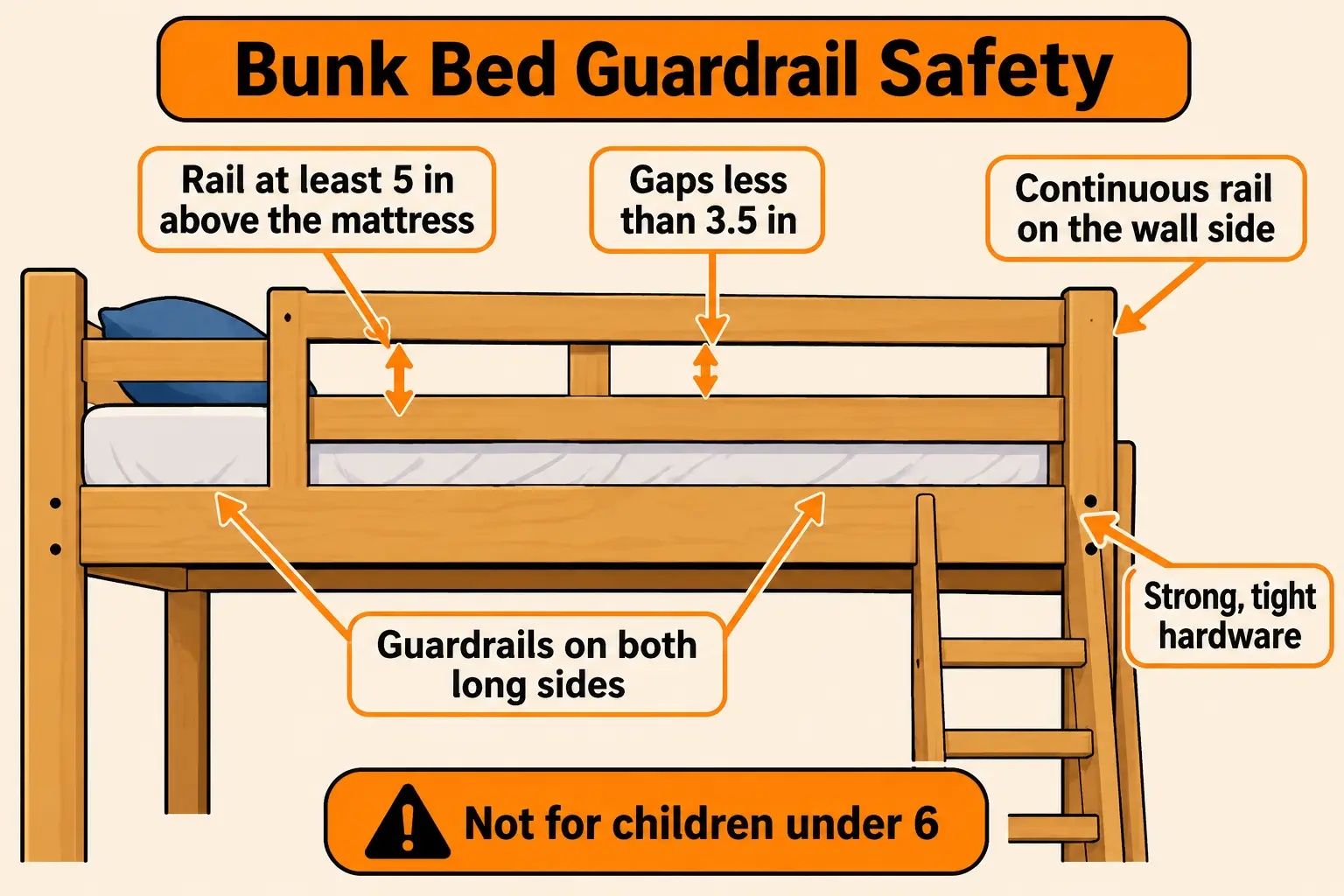
Height: The upper edge must be at least 5 inches above the top of the mattress.
Gaps: Openings between rails and the frame should be less than 3.5 inches to prevent head entrapment.
Both sides: The top bunk needs guardrails on both long sides, and the wall side rail should be continuous.
Age: Children under 6 should not sleep on the top bunk.
Genuine parts: Use rails and accessories made for your bed, not guesswork.
What Is a Bunk Bed Safety Rail?
A bunk bed safety rail (also called a guardrail, safety guard or safety bar) is a barrier along the open sides of the top bunk. It rises above the mattress so a sleeping child cannot roll off. On most bunk beds, the guardrails are built into the frame, and they are usually wood or metal, with either solid panels or slats.
Bunk bed safety rails are different from the following items.
Item
What it is
Replaces a guardrail?
Guardrail
Built-in or bolted-on barrier along the top bunk
Required on the top bunk
Rail extension
Add-on piece that raises a rail's height
Sometimes, if made for the bed
Safety net
Mesh barrier attached to the bunk
No, it is an accessory
Bed bumper or pad
Soft cover over the rail
No, it only cushions
Safety gate
Barrier across an access opening
Only on beds designed for it
Why Are Bunk Bed Safety Rails Important?
Falls are the most common bunk bed injury, and the top bunk is where the highest falls happen. A rail that is too low, loose or missing lets a child roll over the edge in their sleep. Rails also help prevent a second problem: entrapment, where a child's head or body gets caught in a gap between the rail, the mattress and the frame.
Three things make a safety rail effective:
Height: Tall enough to stop a rolling child, even with a mattress on the bed.
Continuous coverage: No large openings along the sides.
Small gaps: No openings that could trap a child's head or body.
CPSC data on bunk bed deaths shows that falls and entrapment are the main hazards, and that is why federal rules set the guardrail and opening requirements below.
Bunk bed guardrail safety: rail height, gap size and coverage at a glance.
Looking for a bunk bed for your kids' room?
Browse kids furniture at My Furniture Mart and check each listing for guardrail height and safety information. Questions? Call us.
When shopping for bunk beds, look at the kids furniture collection and check each listing for guardrail height, maximum mattress thickness and safety information.
Top Bunk Bed Safety Rail vs Safety Net
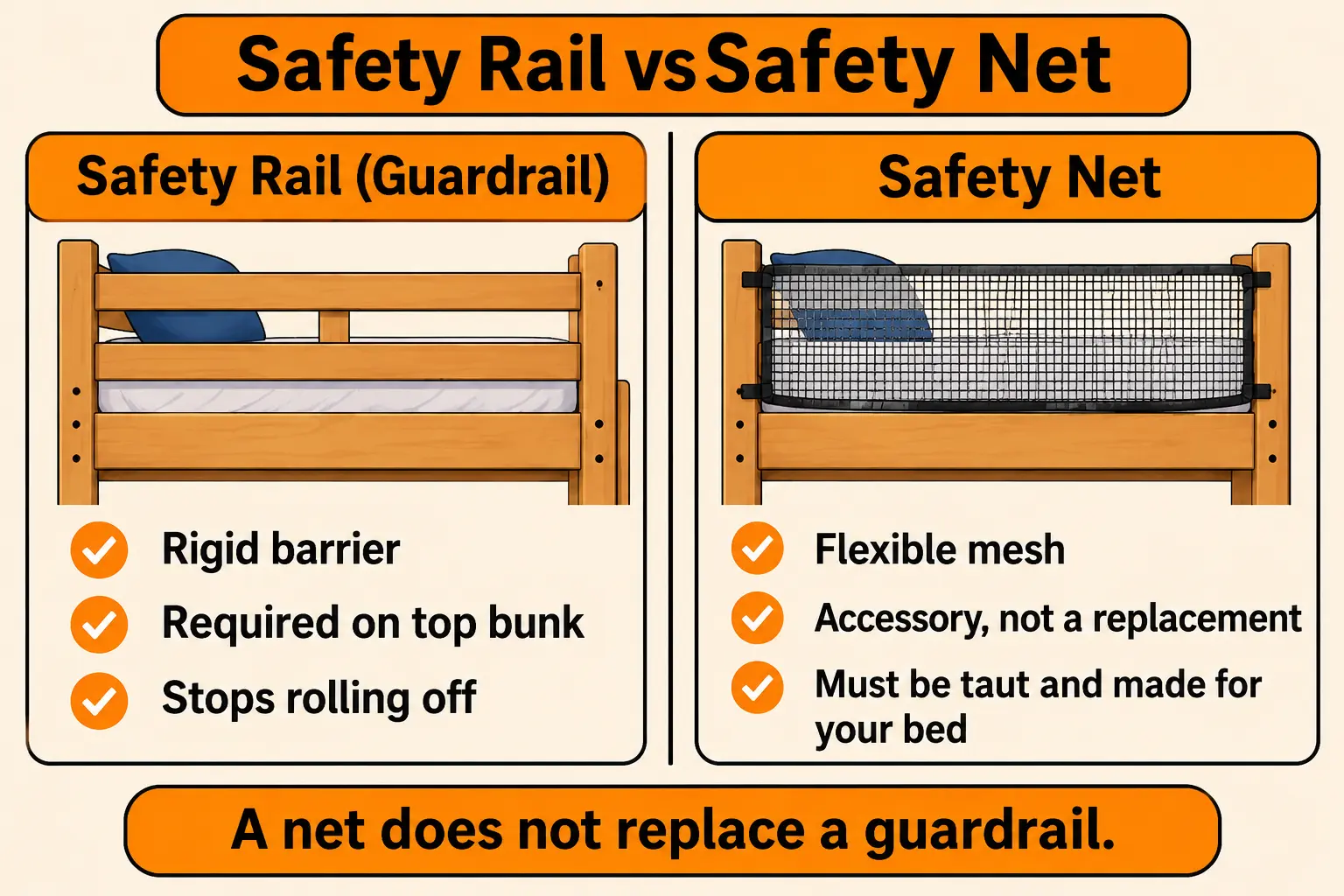
A safety rail and a safety net do different jobs, and they are not interchangeable.
Feature
Safety rail (guardrail)
Safety net
What it is
Rigid barrier on the bed frame
Flexible mesh panel
Required on top bunk?
Yes, on both long sides
No, it is an accessory
Main job
Stop a child rolling off
Add protection or close a gap
Strength
Rigid and built to be load-bearing
Flexible and not designed to replace a rail
Typical use
Every top bunk
Some RVs, campers and special setups
Risk if wrong
Falls and entrapment
Loose netting can create gaps or entanglement
The simple rule: A net does not replace a guardrail on a household bunk bed. If you use a safety net, choose one made for your bed or RV bunk, install it exactly as instructed and keep it tight.
Safety rail vs safety net: a net does not replace a guardrail.
Bunk Bed Safety Standards and CPSC Guidelines
In the United States, bunk beds are covered by CPSC rules, including 16 CFR Part 1513 (requirements for bunk beds) and 16 CFR Part 1213 (entrapment hazards in bunk beds), and by the voluntary ASTM F1427 standard. These are the main requirements that affect safety rails.
Requirement
What it says
Guardrails on the upper bunk
Guardrails are required on both sides of the upper bunk, and one guardrail must be continuous between the end structures
Guardrail height
The upper edge must be at least 5 inches above the top surface of the mattress, using the maximum mattress thickness the manufacturer allows
End structures
The head and foot ends of the upper bunk must also rise at least 5 inches above the mattress for much of their width
Openings and gaps
Openings in the bed structure should be less than 3.5 inches, and gaps between 3.5 and 9 inches are an entrapment hazard
Wall-side rail
The guardrail on the wall side should be continuous so a child cannot slip into the gap
Warning labels
Beds must carry warnings, including that children under 6 should not use the upper bunk
Maximum mattress thickness
The manufacturer states the maximum mattress thickness so the rail stays high enough
The federal rules apply to bunk beds sold for residential use. If you buy a bed for a school, camp or commercial use, other requirements may apply. Check the CPSC website and the manufacturer's instructions for the latest details.
What Age Is Safe for the Top Bunk?
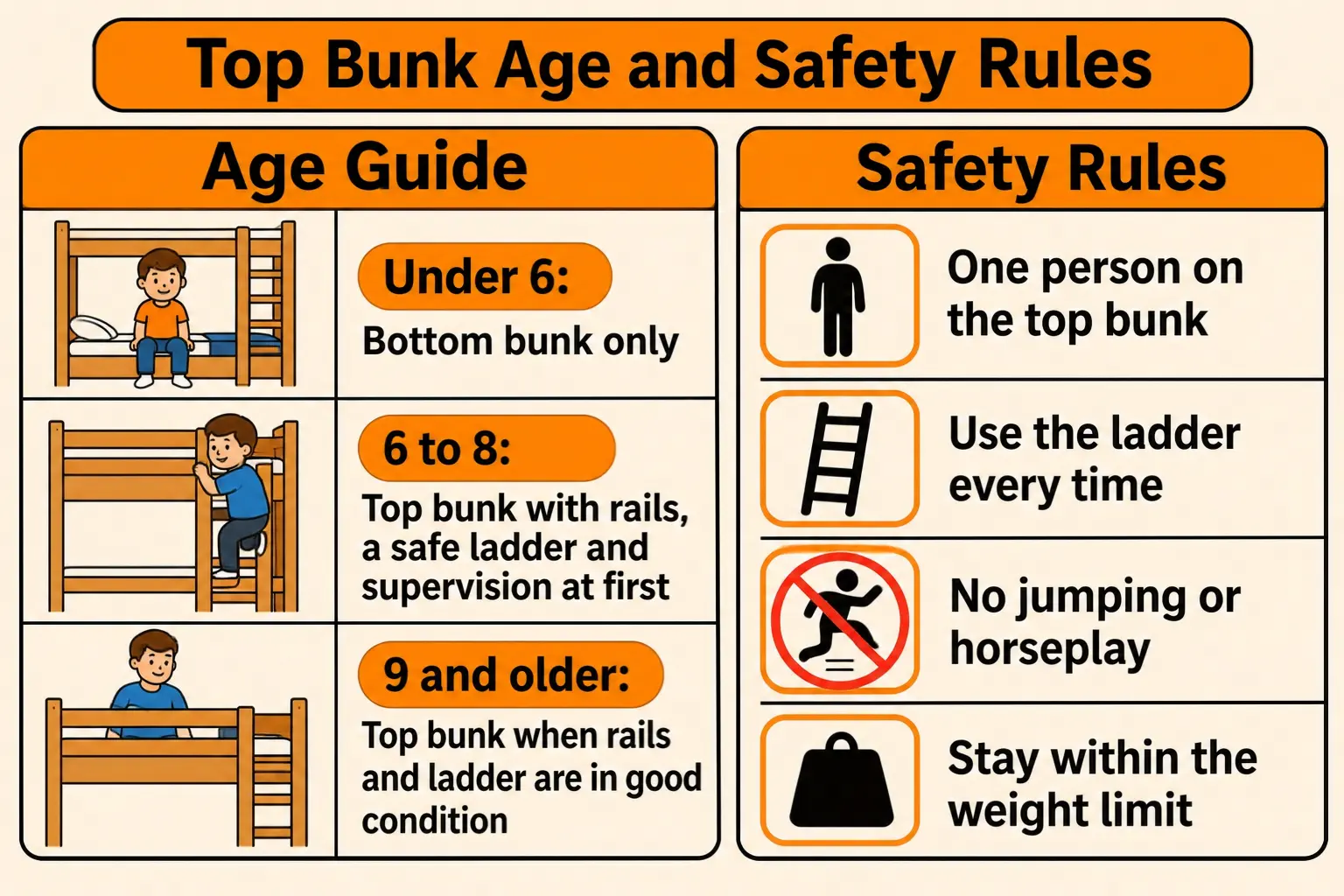
The CPSC and pediatric safety groups advise that children under 6 should not sleep in the top bunk. Younger children are more likely to fall, lack the coordination to climb a ladder safely and are more at risk of serious injury.
Age
Top bunk guidance
Under 6
Should not use the top bunk
6 to 8
Can use it with proper rails, a safe ladder and supervision at first
9 and older
Generally fine when rails and ladder are in good condition
Teens and adults
Check the bed's weight limit and the rail height for the mattress
Age is only part of the decision. A child who is 6 or older should also climb the ladder confidently, follow the rules about no jumping or horseplay and sleep without frequently rolling. Only one person should use the top bunk at a time, and always stay within the bed's weight limit.
Top bunk age guidance and the basic safety rules for every child.
Questions about bunk bed safety or sizing?
Tell us your room size and your child's age, and we will help you choose a suitable bed.
The rail's upper edge must be at least 5 inches above the top of the mattress. That means the rail height depends on the mattress thickness, including any pad or topper you add.
Mattress thickness
Minimum rail height above the slats or foundation
6 in
11 in
8 in
13 in
10 in
15 in
12 in
17 in
The simple formula is mattress thickness plus 5 inches. Many bunk beds specify a maximum mattress thickness, often around 6 to 8 inches, because a thicker mattress lowers the effective rail height. Never use a mattress thicker than the maker allows, and do not add a thick topper on the top bunk without rechecking the rail height.
How to check your rail: Place the mattress on the bed, measure from the top of the mattress (including any pad) to the top of the rail on all sides, and make sure it is at least 5 inches. If it is less, use a thinner mattress or a manufacturer-approved rail extension.
How to Install a Bunk Bed Safety Rail
Most bunk beds come with guardrails that attach during assembly. If you are installing or replacing a rail, follow the manufacturer's instructions and use only parts made for your bed.
Read the instructions. Check which parts and hardware are included and what tools you need.
Check the part numbers. Make sure the rail is made for your bed model, including the right length and bracket style.
Place the bed correctly. Put the continuous guardrail against the wall so there is no gap between the bed and wall.
Attach the rails with the supplied hardware. Use the bolts, brackets and washers that came with the bed.
Tighten everything. Make sure there is no wobble, and use a tool to check the hardware is fully tightened.
Check the height. Measure from the top of the mattress to the top of the rail, and confirm it is at least 5 inches.
Check for gaps. Make sure no gap between the rail, mattress and frame is large enough to trap a child's head.
Test the rail. Push firmly on it from the inside. It should not move, flex or shift.
Re-check regularly. Tighten bolts every few months and after moving the bed.
Note: Do not drill into or modify the bed frame, and do not use a rail that was not designed for your bed. A rail that does not fit can create new gaps and become less safe than no extension at all.
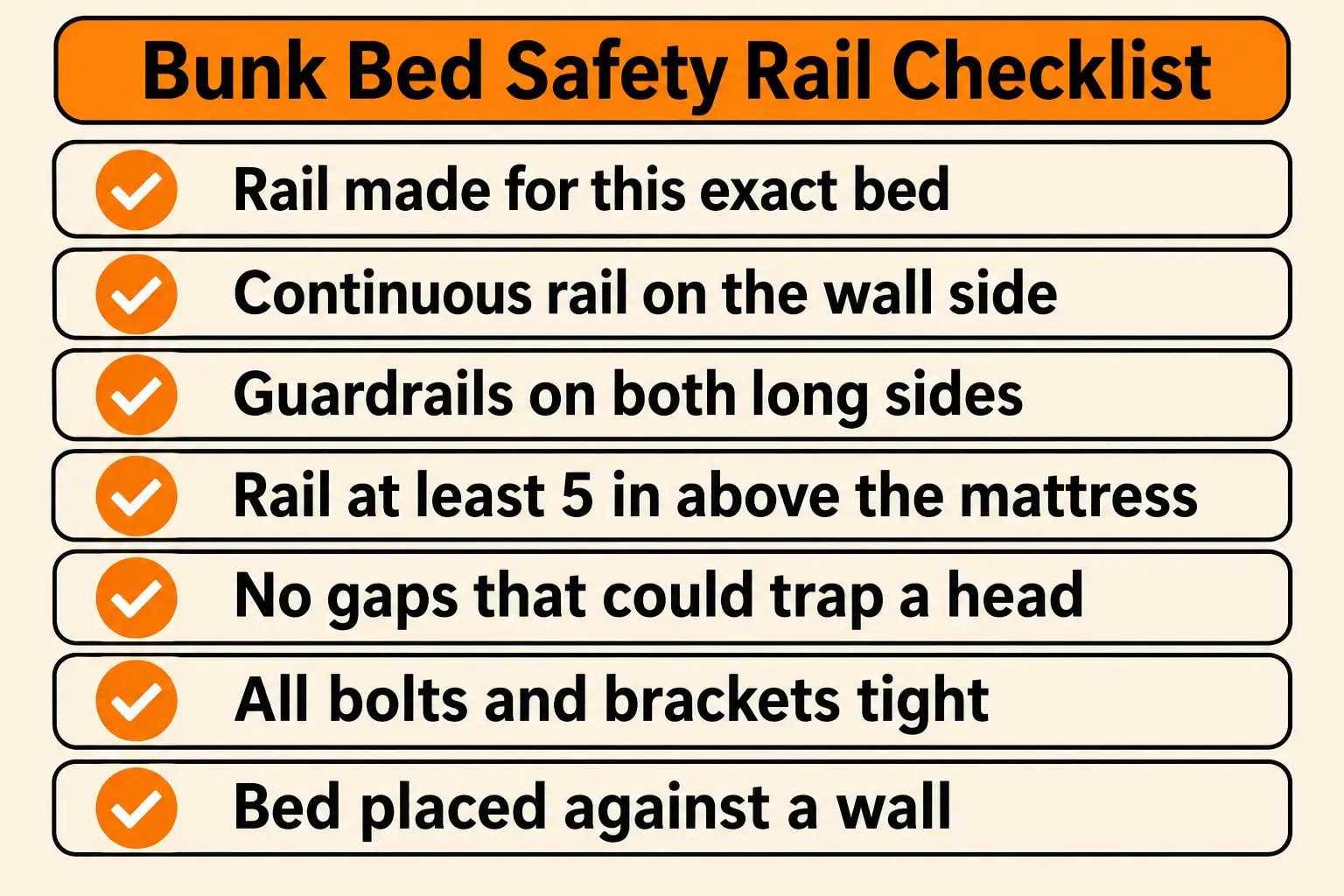
Safety rail installation checklist
Rail made for this exact bed
Continuous rail on the wall side
Guardrails on both long sides of the top bunk
Top of rail at least 5 inches above the mattress
No gaps that could trap a head
All bolts and brackets tight
Bed placed against a wall where possible
A seven-point checklist for installing and checking a bunk bed safety rail.
Want a second opinion on your bed setup?
Send us the bed details or photos, and our team will point you to the right next step.
The ladder is the second most important safety feature after the rail, since many falls happen while climbing.
Make sure the ladder is secure. It should be firmly attached to the bed and not move when you climb.
Use the ladder every time. Children should climb in and out of the top bunk only by the ladder, never by climbing on rails, furniture or the lower bunk frame.
Check the rungs. They should be sturdy, with a good grip and no splinters or loose parts.
Keep the area clear. Do not leave toys, shoes or clutter at the base of the ladder.
Use a night light. A small light helps kids find the ladder in the dark.
Ban horseplay. No jumping, wrestling or hanging off the bunk.
Teach safe climbing. Climb facing the ladder, using both hands.
Limit the load. Only one child on the top bunk, and always within the bed's weight limit.
RV and Camper Bunk Bed Safety Rails
Bunks in RVs, campers and caravans are built differently from household bunk beds. They are often attached to the vehicle wall or ceiling, may have a sloped or narrow shape and can have a different type of restraint, such as a mesh net or a fold-up rail.
Follow the RV maker's instructions. Use only the net, rail or restraint that came with the bunk or is approved for it.
Make sure the net is tight. A loose net can leave a gap or tangle a child.
Check the attachment points. Hooks, straps and anchors should be firmly fixed, and should be checked before every trip.
Be careful with age. The same guidance applies as at home: young children should sleep on the lower bunk, not the top.
Check for gaps and head clearance. Avoid openings that could trap a head and be aware of low ceilings.
Never improvise. Do not use rope, straps or household items as a substitute for a made-for-purpose restraint.
DIY Bunk Bed Safety Rail Ideas
Buying a rail made for your bed is the safest option. Some people still look for DIY solutions, so here are ways to improve safety without making things worse.
Safer DIY ideas:
Add padding. Foam or fabric rail covers cushion bumps, but do not count toward the rail height.
Build a wall-side barrier from the manufacturer's plans. If the bed maker publishes a rail plan, follow it exactly.
Add a night light and non-slip ladder treads. These reduce climbing falls without changing the structure.
Place the bed in a corner. Walls on two sides reduce fall risk.
Put a soft rug at the base of the bed to cushion any fall from the lower bunk.
What to avoid:
Homemade rails of any wood or pipe. A rail that is too low, too thin or poorly attached can give a false sense of security.
Gaps between 3.5 and 9 inches. These can trap a head.
Rope, bungee cords or fabric straps as barriers. They can loosen or cause strangulation.
Drilling into the frame. This can weaken the structure.
If you do make or modify a rail, it should still meet the same targets as a manufactured one: at least 5 inches above the mattress, gaps under 3.5 inches, no wobble and secure fastening. When in doubt, buy a rail made for your bed model or ask the manufacturer.
How to Choose the Right Safety Rail
Check
What to look for
Why it matters
Fit
Made for your exact bed model
Prevents gaps and weak attachment
Height
At least 5 inches above your mattress
Stops rolling over the rail
Gaps
Less than 3.5 inches, none between 3.5 and 9 inches
Prevents head entrapment
Coverage
Guardrails on both long sides, continuous on the wall side
Closes the sides of the top bunk
Material
Solid wood or metal with strong joints
Handles daily use and movement
Hardware
Bolts, brackets and washers, tool-tightened
Prevents loosening
Mattress limit
Check the maximum mattress thickness
Keeps the rail high enough
Warnings and labels
Present and clear
Shows compliance with labeling rules
Warranty and support
A clear warranty and available replacement parts
Makes repairs easier
Quick buying guide
Your situation
Best choice
Buying a new bunk bed
A bed with integrated, full-length guardrails and clear safety labels
Using a thicker mattress
A bed rated for it, or a manufacturer-approved extension
RV or camper
The RV maker's net or rail, installed exactly as instructed
Child under 6
Use the bottom bunk, not the top
Teen or student in a small room
A sturdy bunk or loft with full rails and a secure ladder
Existing bed with a rail that is too low
A manufacturer-approved extension or a thinner mattress
Conclusion: Safe Sleeping Starts with the Right Rail
A good bunk bed safety rail is at least 5 inches above the mattress, closes the sides of the top bunk with no dangerous gaps, is made for your bed and is firmly attached. Add a sturdy ladder, place the bed against a wall, keep children under 6 on the bottom bunk and check the hardware regularly, and a bunk bed can be a safe and space-saving choice.
The upper edge of a bunk bed safety rail should be at least 5 inches above the top of the mattress, including any pad or topper. To check, add 5 inches to your mattress thickness. For example, an 8-inch mattress needs a rail at least 13 inches above the slats. Follow the bed maker's maximum mattress thickness so the rail stays high enough.
What age is safe for the top bunk?
The CPSC and pediatric safety guidance say that children under 6 should not sleep in the top bunk. Children aged 6 and older can use it if the guardrails and ladder are safe, they can climb confidently and follow the rules about no horseplay. Only one person should use the top bunk at a time.
Is a bunk bed safety net enough on its own?
No. On a household bunk bed, a safety net does not replace a rigid guardrail. The top bunk needs guardrails on both long sides at the required height. A net can add protection in some setups, such as RVs and campers, but only if it is made for that bed, installed as instructed and kept tight.
Do both sides of the top bunk need guardrails?
Yes. The upper bunk needs guardrails on both long sides, and the rail on the wall side should be continuous with no gap. The side used to reach the ladder may have a limited opening, which the bed maker designs to meet safety rules. The head and foot ends of the top bunk should also be high enough above the mattress.
Can I add a safety rail to any bunk bed?
No. Only add a rail or extension made for your bed model, or approved by the manufacturer. A rail that does not fit can create gaps that trap a child or can loosen under load. Do not improvise with homemade rails, rope or straps, and do not drill into the frame. If your rail is too low, use a thinner mattress or ask the manufacturer for an approved extension.